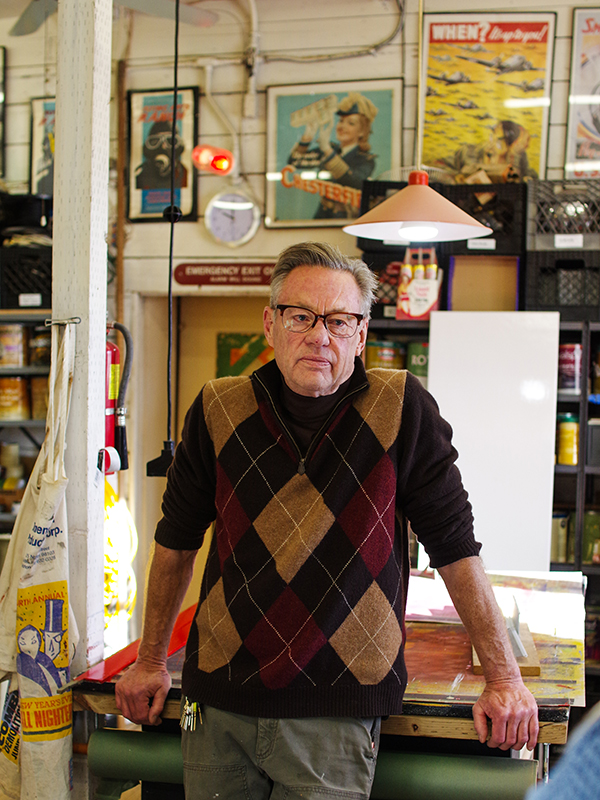
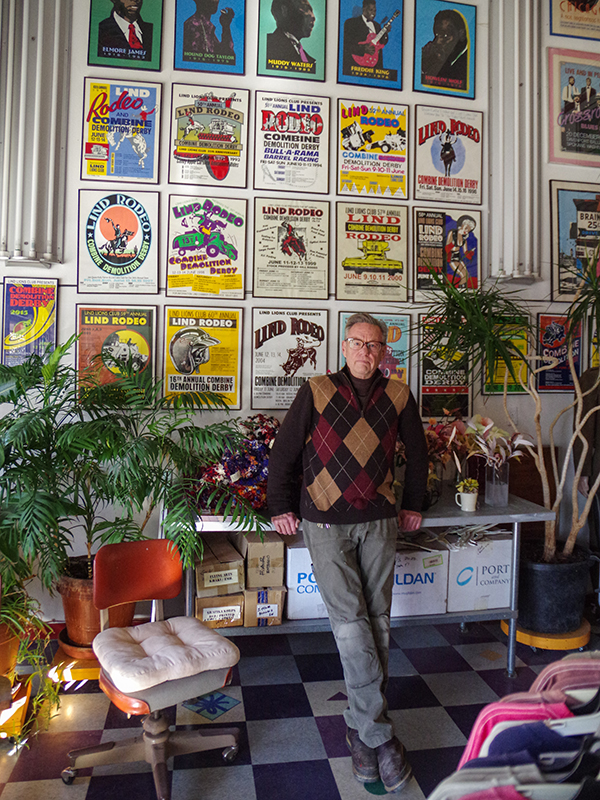
Sometimes there’s a man. I won’t say an artist because what’s an artist? He fits right into his time and place, and that’s John Rankin. Ritzville is not where John expected to settle, but it is where he’s made his life. “Just by the luck of things, the way the cards are dealt, I ended up here,” he explained.
Born in Los Angeles, with some time in Spokane as a child, and after architecture and art studies at University of Idaho in Moscow, John spent his roaring 20’s in Seattle where he worked in storefront restoration for a commercial business and freelanced sign painting for clients like Bumbershoot (1982-90) and Folk Life. “Not posters, signs – big ass signs, 30’ long banners, 100-200-300 square foot big graphic stuff,” he said.
John landed in the Basin in 1991 when he moved to a farmhouse near Lind. He grew up driving through the channeled scablands between Spokane and Seattle when everyone thought the landscape of large hills and piles of rocks were Native American burial mounds. He remembers when Harlan Bretz’ theories of the ice and great floods reached the general public and it finally all made sense to him. He found the history so compelling he decided to move to the area and eventually became a founding member of the Ice Age Floods Institute. “This is where my dream stops. It wasn’t necessarily exactly this, but it was someplace like this. The dream was to have somewhere built out in the country and this works for me,” he said.
The bad news was even out in the middle-of-nowhere Eastern Washington the owners of the home he moved into wouldn’t allow John to keep his work materials on the property. “I was a self-employed artist with 50 gallons of flammable liquids, a couple of dogs… couldn’t have my flammable liquid there, so I had to find a place to move the sign company because that’s how I support myself,” he said, “Hotter than paint thinner – lacquer, xylitol, acetone, things like that. I’m a commercial guy, I’m into solvents.”
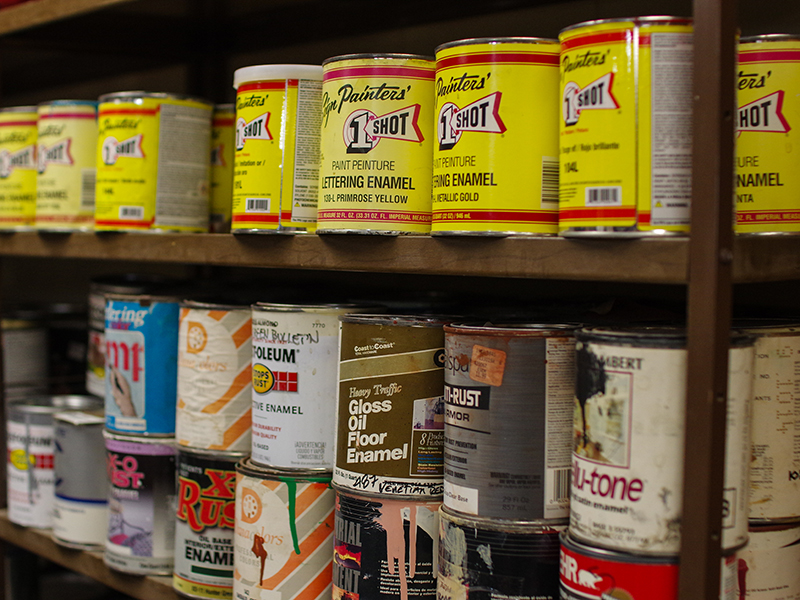
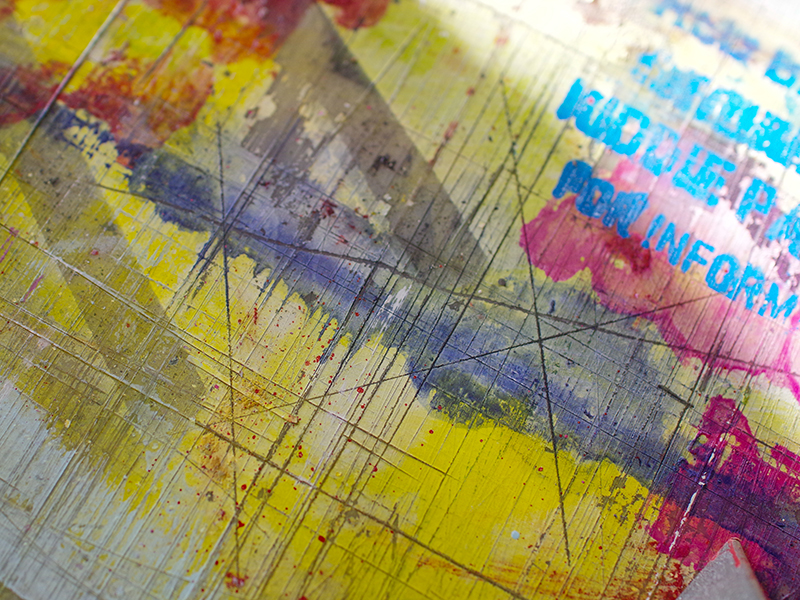
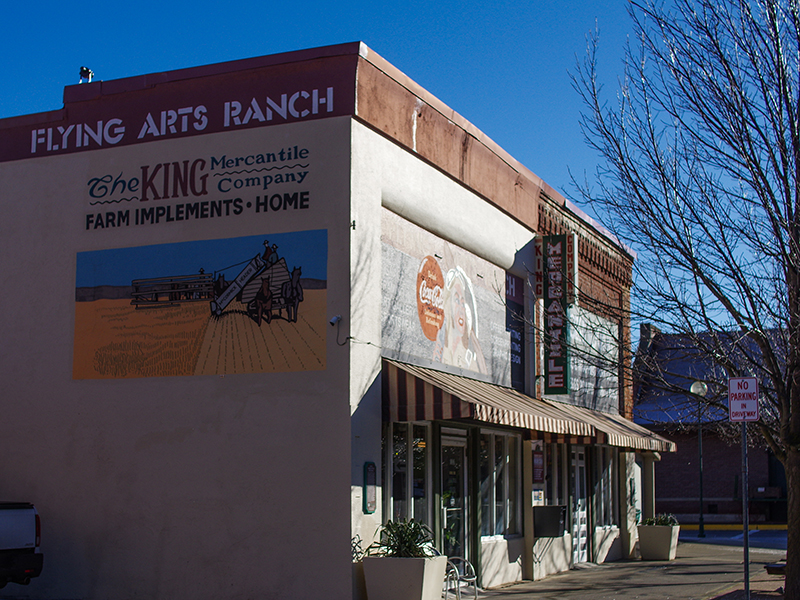
So, John started looking around and eventually found his place in downtown Ritzville, across the street to the Burlington Northern line. Originally the King Mercantile, in turn a butcher shop and cold food locker, and a laundromat is now Flying Arts Ranch. The space feels in flux with the bones of its historic character apparent in the retro fluorescent lights now hung vertically from the walls and framing that once held thousands of pounds of straw for insulating its cold storage, mixed with the history of its current resident including framed family photos, and all matter of notable graphic art and books hung, shelved and stacked on every surface. Also present are the materials and products of his own work including the original screen press from his graphic design business in Moscow, brushes, cans of liquid, serigraphs, paintings, posters and home improvement projects.
Occupying a significant amount of space in the building – and different spaces through the years – is Linda Kubik’s art and materials. Kubik is a native of Ritzville, a nationally-known weaver and clothing designer, and John’s life partner. “She’s way more famous than I am – I’m more infamous locally, she’s more famous nationally,” John said. They work together on various projects like restoring and operating the historic Ritz Theater, and designing and building new storefront awnings in downtown Ritzville – but honestly, Kubik is a whole other story.
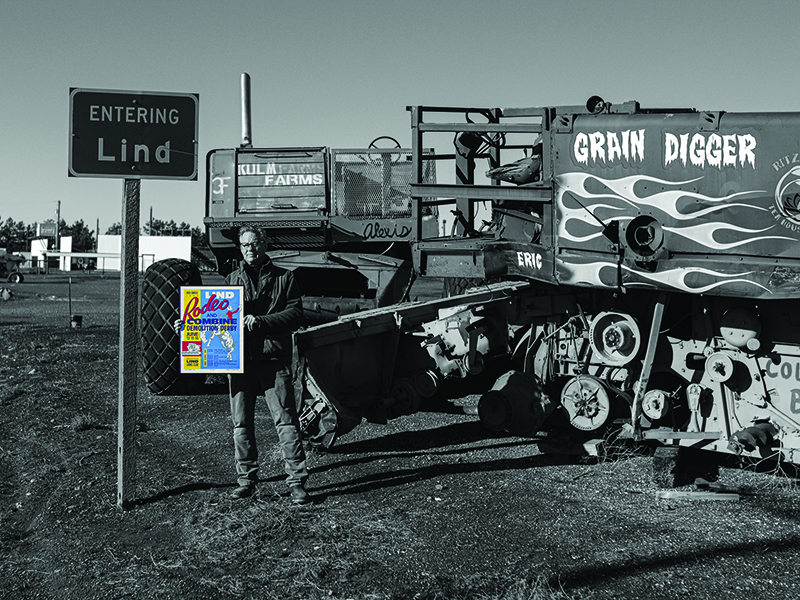
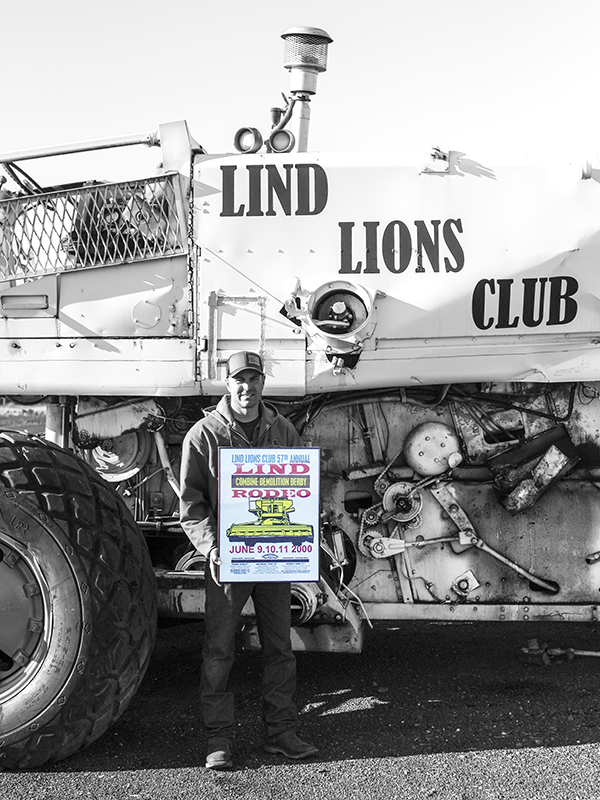
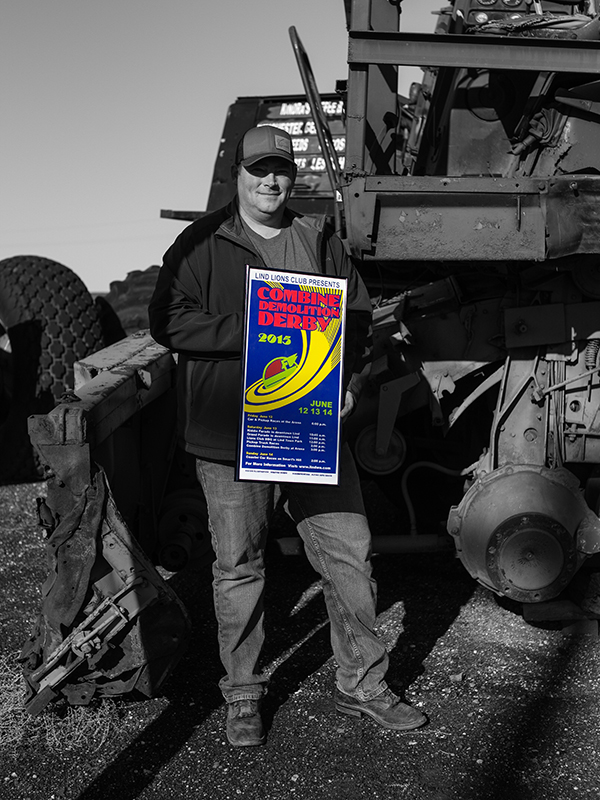
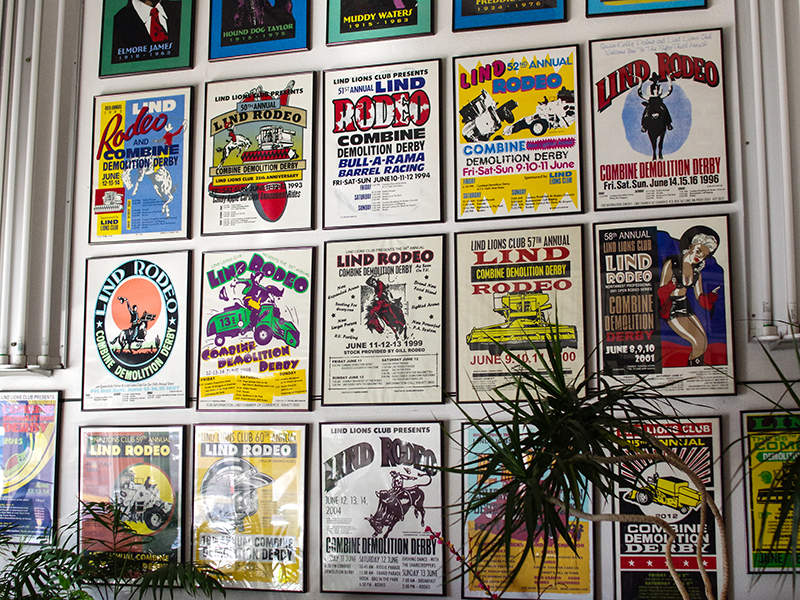
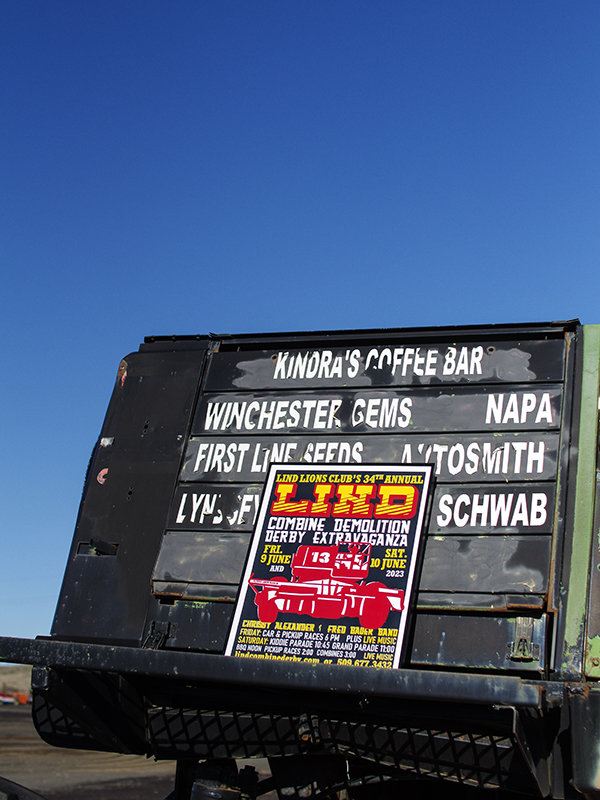
While the studio was in flux and taking shape through the years, John wasted no time settling himself into his new communities. “When I moved here in ‘91 I knew one neighbor in Lind. I came out right before Demo Derby started, so I got put to work in the cook shack since I had done that in a previous life. So, I spent three days cooking hamburgers, looking around, and the graphics were four-by-eight signs with CDX plywood with red, six inch letters stenciled. I thought I could really help these guys out, since that’s what I did,” he said. The Demo he referred to is the Lind Combine Demolition Derby – a unique and awesome event for anyone who likes agriculture, machines, engines, the rural way of life, things you won’t see anywhere else, or having a good time. John joined the Lind Lions Club, who hosts the Demo, and since that first year has designed and produced the signs and posters for the event. Production of the annual posters, each a collectible piece of memorabilia, requires pulling paint across several different screens laid in turn on a single page, layering the paint – a work of focus, time and art. Only about 150 posters are made each year.
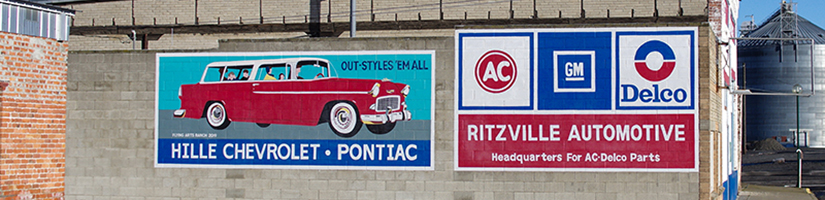
Along with the Demo posters and construction-based restoration projects in downtown Ritzville, John keeps busy with what he calls, and the locals refer to as, ghost signs. These not-mural outdoor wall paintings are based on the hundreds of photos John has access to of the Ritzville historic downtown thanks to several photographers who lived there from the turn of the century through the mid-1900’s. “I’ve got at least a dozen books that are paperback that are full through of photos of what this town used to be like,” he said, “I’ve never seen a small town that was so researched so you have so much source material.”
The idea of ghost signs is to restore historic signage that has been painted over or sandblasted off, “whether it was painted 100 years ago or if I was there 100 years ago, what I would have painted, because 100 years ago they would have only had black and white,” he said. As a longtime member of the Downtown Development Association, John likes the idea of preserving the historic buildings of the area while also making the space more visually appealing and exciting for new business owners, and customers. He has ghost signs painted in or planning in communities across the region including Ritzville, Lind, Harrington and Wilson Creek.
He also worries about the future of the community. “People don’t have that sense of community or pride of community… If they didn’t have that sense of pride from where they came from, when they move from somewhere else then they won’t have pride when they move here. I’m not saying generation-wise, but when people move they don’t have a tendency to donate and get involved. They’re just their own thing,” he said. This somewhat modern mindset has effected the downtown, where new businesses are lucky to last more than six months, and the 40-year-old Demo that now has to pay volunteers to help work the event. “It’s a big stack of one-hundred-dollar bills to buy the community support!” he said. That, for an event where 100% of its proceeds go to local programs and non-profits.
Despite, and in many ways thanks to his commitment to his community, John has led a life he can easily say was his own. He followed his head in business enough to support his art. But is he an artist? “Artist is a really general term. Lots of stuff I do is like a craftsman. A lot of stuff I do is like a contractor… You tell somebody, for all the different things I do, you tell someone you’re an artist and they go, ‘Oh! what do you paint – watercolor?’ and it’s a little more evolved than that,” he said. “I’m just driven by the work that I do and enjoy doing it,” he said, “I’m not driven by money. I do what I want to do.”