
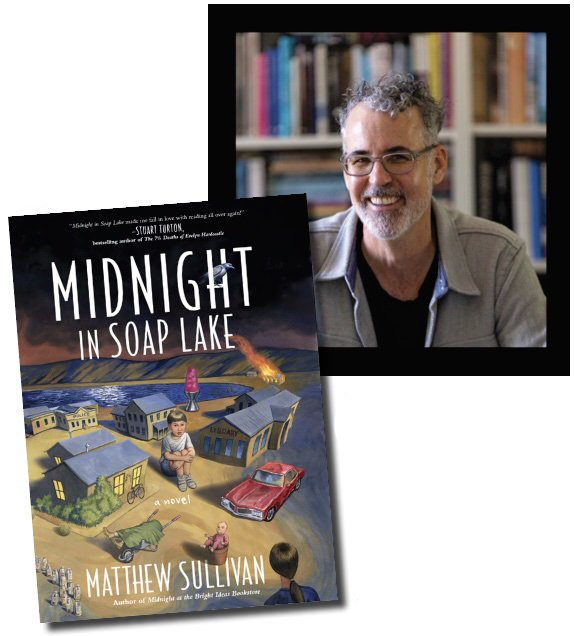
Matthew Sullivan, Washington State author and previously tenured English instructor at Big Bend Community College near Moses Lake, releases his second novel, Midnight in Soap Lake, on April 15th. Matt’s highly anticipated “cozy horror” novel blurs the boundary between mystery, suspense, and horror, a newfound addition to a subgenre of horror fiction.
Matt, a former resident of Soap Lake and Ephrata, fascinated by the ripple effect on the tight-knit communities of a small, rural, sleepy town when something goes awry, felt it was fitting that a fictional Soap Lake be prominently featured in his mystery novel because of the emotional connections that could be explored. In small towns, everyone knows each other or at least thinks that they do, which makes for excellent conflict, whether gossip or conspiracy, which can lead to accompanying folklore.
By drawing upon what he learned from his students during his time at Big Bend, Matt believes rural students going to a community college experience distinct and powerful outcomes more than other student populations or types of colleges, “I felt like I was doing kind of my best work with that population of students. And in part, I think, because there’s a groundedness or a sense of reality that maybe other student populations aren’t necessarily as in touch with.”
Matt’s first and second novels fit into what he describes as The Midnight Cycle, featuring three stand-alone mysteries in the same universe but in different places. Matt shared there will be a few Easter eggs in each book that will connect them all thematically, “There is always some incident or some crime that acts as a seed, or kind of the prime mover that starts everything else in motion that has a ripple effect on everybody else in the story. They are all these kinds of tight, colorful, knowable communities.”
While Matt has not been teaching for the past two years, he enjoys focusing on writing full-time and volunteering and mentoring when he can. Now living in Anacortes, WA, with his wife, Libby, who is a librarian at Skagit Valley College, and an artist in her free time, Matt felt ready to return, in writing, to a place he knew well but no longer lived: Soap Lake, “If every day you walk out inside your door and you see the world as it is, to write about that world would feel constrained by reality, whereas, speaking of nostalgia, if you move away from it and have this version of it that occupies your memory, it makes a better way to world build.”
Midnight in Soap Lake was not the original title of Matt’s second novel. In fact, the original title was a bit longer and did not call attention to its location in such an obvious manner. The original title, Midnight in the Orchard by the Lake, would have had the same rhythm as his first novel, Midnight at the Bright Ideas Bookstore. Matt’s editor felt Soap Lake should be part of the title and featured on the book’s wraparound cover.
Someone browsing a copy of Midnight in Soap Lake on a bookstore or library shelf might think the cover is unusual. In talking about the wraparound cover, Matt described it as “warped,” something that he and his editor leaned into with the artist, wanting it to showcase a “heightened, more freaky version of reality.” Matt’s editor had been inspired in part by Desperation, a 1996 horror novel by Stephen King, and wanted a book cover that was almost like a map of the neighborhood, “It’s kind of neat. It’s very different. You would never know that if you didn’t put them side by side. But if you do put them side by side, it’s like, ‘Oh, I see what he’s doing here.’ Soap Lake encompasses every aspect of this book.”
After having read an advance copy of Midnight in Soap Lake, it is evident that Matt, as a writer, with characters like Abigail, Esme, George, Daniel, and Sophia, views Soap Lake and, by default, rural Central Washington, with skeptical love and wonder. As a librarian myself, it was beyond heartwarming to see the Soap Lake Public Library play such a prominent role in the community, something every librarian hopes for.
While I typically stay as far away as possible from horror as a genre, Matt left me believing that there might be something tempting about cozy horror: it is a bit silent, a tad deadly, full of homeliness and familiarity, and without too much gore, yet all of the suspense. Truthfully, I have never been more tempted to know what is happening behind my neighbors’ closed doors across the road or more determined never to find out because, as we know, curiosity killed the cat.
Ultimately, Matt pays homage to a place in his past, nostalgic in nature, a place many of us here in Grant County know well, where anything can happen, the good, the bad, or perhaps, the in-between. Soap Lake impacted Matt and his family, as it was affordable and interesting with its natural history, the mineral lake, and its creative community, “I think that’s one of the things that I find so wonderful about Soap Lake is it is jaw-dropping. We become so accustomed to a place like that without thinking how this place is like one in a million. It’s so unique on so many different levels.”
As an author, Matt has a knack for exploring dark things in a safe way, able to interweave light and darkness for his readers while balancing it out with quirky humor centered on his characters’ emotional connections and experiences, describing, “This is Midnight in Soap Lake. This is what happens after dark in this fictionalized version of a real place. And so, for me, this is a sinister book. This is a dark book. It’s not all dark, but it’s crime fiction, so it has to build on things that are sometimes uncomfortable, disturbing, and scary.”
I am proud to call Matt a local author and honored that he has found his niche as a mystery writer. I look forward to reading Midnight in Soap Lake with my book club in May and will recommend this book to anyone who wants a writer invested in balancing the darkness, and who does not shy away from writing an alternate Soap Lake, a diamond in the rough, and as Matt mused, “It’s had ups and downs, and places come and go, and that’s all part of it, too, that it’s not this polished, perfect, wonderful, idealized, suburban place. It’s like a place that’s real.”
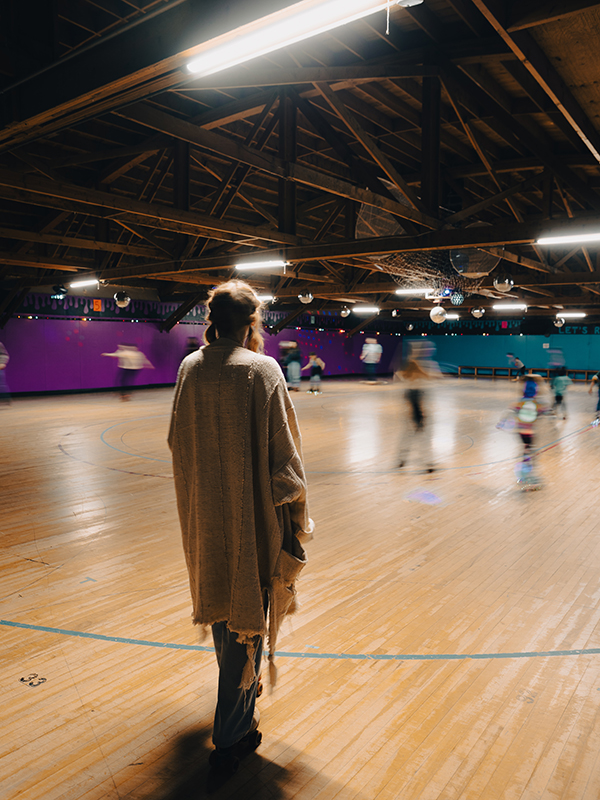
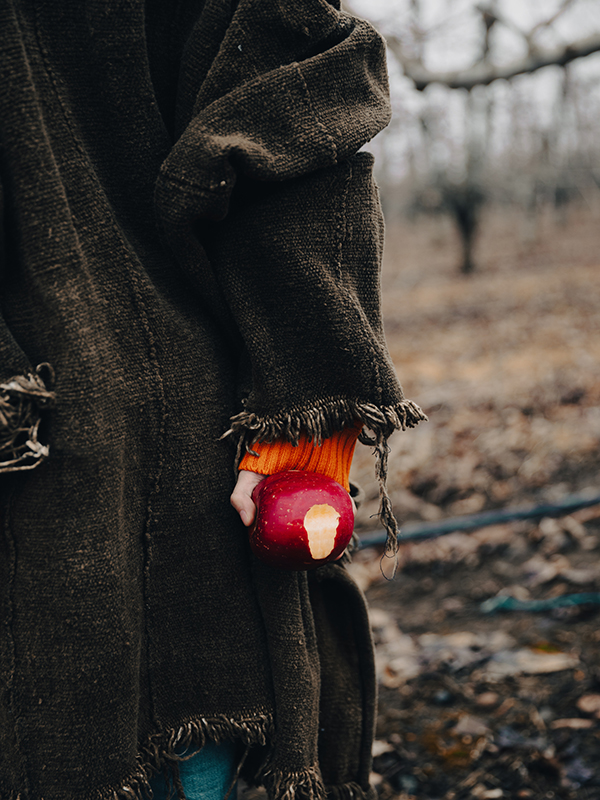
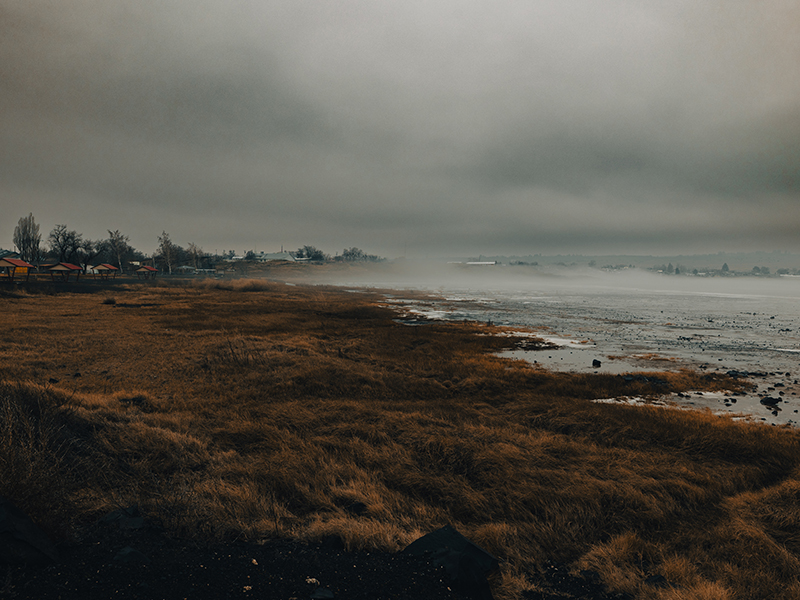
Photographs by Xalt Photo • Models Cayden Banister, Blisa Preston • Outerwear by BUMI Essentials • Special thanks to Neon Skateway
Excerpt of Midnight in Soap Lake by Matthew Sullivan
Esme’s mom stared a lot. Sat in her chair with a hairbrush in her lap and a glass on the card table as she stared at the television. She also stared at the holes in her slippers, at the scratches on the armrest, and into the drain of the bathroom sink. But more than anything she stared at Esme: Esme eating Trix out of her mermaid bowl. Esme pouring Pepsi into her mermaid cup. Esme coloring in her coloring book or untangling her bag of yarn or clenching her crusty Play-Doh. It didn’t matter what Esme was doing, her mom was usually staring.
Her brother, Daniel, was also still asleep, not that it mattered. When he woke up he was like an animal emerging from a cave. He’d shuffle around with his head down and play his Game Boy while putting a frozen hot dog in the microwave, and continue to play it as the hot dog overheated and burst open and made the trailer reek of salty meat for days.
The couch this morning was empty. Dad wasn’t on it, which meant Dad hadn’t come home last night.
From the other room, a shifting of the mattress. Mom awake.
Esme left her breakfast bowl on the carpet. She grabbed her coat and crammed her feet into her boots and just as she was slipping out the door, she turned and saw her mom emerging from her bedroom, wearing her threadbare nightgown, staring across the trailer.
“Going outside!” Esme yelled, and leaped off the porch.
*
Esme’s father had made it clear that she was not allowed to leave the trailer park under any circumstances, and she was not allowed to wander the streets of Soap Lake alone, and she was especially not allowed to play in the apple orchards that stretched into the desert from the edges of town. But her father wasn’t around to stop her, so Esme walked out of the park on the shoulder of a cracky road. She passed the rusty playground by the lake where she and Daniel played a game called Tetanus Island, in which they tried to climb from the slide to the swings without getting scraped by old bolts and chains. She cut between houses and through fields and looked behind her as she walked, half expecting someone in her family to come running after her.
But no one was coming. Which was the point.
When she got to the orchards, she tucked her pants into the green rubber boots, three sizes too big, that her dad had liberated from the dairy where he worked.
Stepping into the orchard was like disappearing into a forest.
Before her dad got a job bulldozing cow shit into giant piles at the dairy, he used to run a bunch of orchard crews. He spoke Spanish okay enough and had been a wrestler in high school, but mainly, he said, he knew a thing or two about how to motivate people. He also said in the orchards you could eat the apples until your belly hurt as long as you washed them well, but if you breathed the air in there you’d die of cancer and your balls would shrivel up, but not in that order, and not just your balls. Plus, he said bad things happened in those orchards—but he always said it in a ghost story voice between slugs of beer, so she couldn’t always tell how serious he was.
This orchard was the spookiest one around, too. Half of it was dead, with gray skeleton trees that burst out of the ground like giant claws. And the half that was alive stretched to the landfill, where people dumped their old sinks and dead pets. When the orchard owner donated a bunch of apples to the grade school one year, all the kids in the cafeteria bit into them and made faces and swore they smacked of trash.
The sunlight peeked between the apple trees, turning the cold ground misty. Esme liked how the crabgrass and fallen leaves blanketed the rows like a carpet, and how she couldn’t see the desert in any direction, and how the rotting fruit waited on the ground for birds.
Plus she was alone, which was the best thing ever.
And then she wasn’t alone because somehow a sound had found her.
She pushed back her jacket hood. The sound was high-pitched and pulsing.
A crying kitten. Or a hungry bird.
Esme prowled in its direction, slipping between trees, and soon she was deep inside the orchard and not sure which way was out. She stood tall and could hear a tractor starting far away but the squeaky sound had stopped.
When it started again it was just a row of trees away.
Not a kitten or a bird. A wheel.
She crouched under a tree and pressed her back
into its trunk.
no
Her eyes shut and she didn’t move. She felt an earwig on the back of her hand.
no
The squeaks came closer. She should’ve listened to
her dad.
TreeTop.
She’d never seen TreeTop in person but she’d heard stories about him so many times from Daniel and kids at recess and grown-ups at the parade and teachers at school that he’d folded himself into a special cupboard in the back of her brain, one with rusty hinges and cobwebs.
TreeTop killed children and chopped up their bodies to fertilize the town’s apple trees.
Fee Fi Fo Fum
I smell the blood of an Americun
Be she alive or be she dead
I’ll grind her bones to grow my—
Apples.
TreeTop pushed his wheelbarrow full of bones around the orchards all night, its axle screaming in the dark.
TreeTop climbed into the thin branches at the tops of the trees every morning and stretched out to sleep like a spider perched on his web.
Without TreeTop, there would be no orchards, and without orchards, there would be no town.
Everything would be the desert.
The sun was out now, and TreeTop was probably sloshing his last scoops of ground-up child around the trees before climbing into his branchy bed.
How else, Daniel once said, do you think all this fruit grows in the desert?
He was right. It was like magic, watching fruit trees blossom and burst from this hot, rocky land.
She could feel her heart pounding as TreeTop’s wheelbarrow rolled closer. She thought she should run, but her dad had told her plenty of times to never run from the frothy dogs that roamed the roads outside of town and TreeTop was way worse than dogs, so she pressed into the tree and shut her eyes and only opened them when the squeak of his wheel went silent just a foot or so away.
He was far bigger than she’d imagined, wearing a white hooded jumpsuit and a white mask and blue rubber gloves. It was the same uniform she sometimes saw the orchard guys wearing, driving between trees on their ATVs, spraying bright clouds of pesticide behind them to kill the cutter worms and sucker moths. His eyes were covered with protective goggles, and as he breathed they steamed a little, and his mask clicked in and out.
His wheelbarrow basin was covered with a blue tarp.
In its gaps she could see gnarled applewood cuttings, crosshatched over pockets of air—
And a man’s boot.
She clung to the tree but shifted to get a better look. Inside the wheelbarrow, she could see the boot’s black sole and knotted laces and part of its dusty leather tongue. Its sole had a tread of three small clovers near the toes, and Esme couldn’t help but spread out her three little fingers as if she were going to step forward and press the clovers all at once, like they were buttons. But just then TreeTop reached out and sharply tugged the tarp, covering the branches and the boot.
Esme knew she shouldn’t look TreeTop in the goggle, so she dropped her gaze to his stained knees. Everything he wore was spattered brownish, blackish, darkish red.
TreeTop paused for a moment. Then he lifted the wheelbarrow handles, and a rhythmic squeaking filled the air as he disappeared between trees.
*
Back at home Esme dumped her coat and stood by the door, catching her breath. Daniel was stretched out on the couch, playing Game Boy, with his hot dog plate on the floor. Her mom was sitting in her saggy chair and watching a game show on TV.
Her dad’s sneakers were next to the kitchen table, right where he’d left them a few mornings ago, but he was nowhere in sight.
Esme realized why she’d been so scared. It wasn’t because of TreeTop, exactly. Sure, he was as freaky in person as he was in the stories, but he was also strangely calm in the way he just loomed there, as if he’d been expecting her. Plus he hadn’t chopped her to pieces, which was highly comforting. What wasn’t comforting—what was in fact terrifying to consider—was the boot she’d seen in his wheelbarrow, covered with the tarp.
Because question: Why had its laces been knotted?
Because answer: it was still on someone’s foot.
“Mom?”
Her mom looked up and seemed pleasantly surprised to see her. “Don’t leave your breakfast bowl on the floor,” she said. “I stepped in it.”
“Sorry.”